News from our correspondent (by Xue Wenxuan) Recently, the research group of Professor Tang Sheng from the School of Chemistry and Environmental Engineering at our university published a research paper titled "Broccoli-Derived Carbon Dots Composited with Aliphatic Linker Based COFs as Hybrid Functional Modifiers for an Advanced Silica Stationary Phase" in Analytical Chemistry, a top-tier journal in the field of analytical chemistry published by the American Chemical Society. Wuhan Institute of Technology is the first affiliated and corresponding unit of this paper. Ni Fang, a 2024 cohort graduate student majoring in Analytical Chemistry from the School of Chemistry and Environmental Engineering, is the first author. Ziyi Ke, a 2023 cohort undergraduate student majoring in Environmental Engineering, and Ziyi Huang, a 2024 cohort undergraduate student majoring in Applied Chemistry, are the second and third authors, respectively. Associate Professor Sheng Tang serves as the sole corresponding author. The research was supported by the National Science Foundation of China, the Hubei Provincial Natural Science Foundation, and the Graduate Innovation Fund of Wuhan Institute of Technology.
Broccoli Water Extract-Derived Carbon Dots (BWE-CDs) offer advantages such as natural origin, low cost, high stability, and good hydrophilicity. Covalent organic frameworks (COFs) constructed from aromatic building blocks exhibit significant hydrophobicity, which limits their application in hydrophilic separation. In recent years, aliphatic linker-based COFs (ALCOFs) have been recognized as effective modulators for balancing hydrophilicity and hydrophobicity. Therefore, Associate Professor Sheng Tang's team proposed a strategy to composite BWE-CDs with ALCOFs for the construction of a novel chromatographic stationary phase. BWE-CDs synthesized in water as the reaction medium and ALCOFs with tunable hydrophilic/hydrophobic properties were grafted onto aminated silica via a one-pot method, successfully yielding the high-performance BWE-CD/ALCOF@Silica composite material.
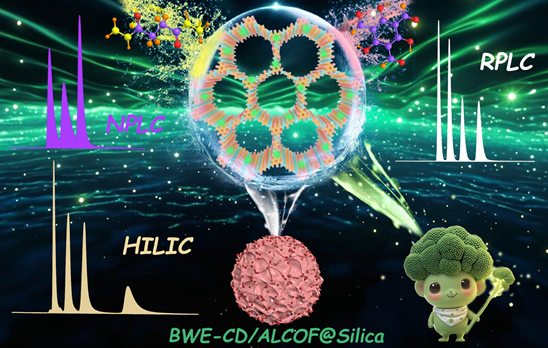
The synergistic effect between ALCOFs and BWE-CDs significantly enhanced the hydrophilicity and separation selectivity of the stationary phase. The BWE-CD/ALCOF@Silica composite stationary phase exhibited excellent separation performance for nucleosides, B vitamins, antibiotics, polycyclic aromatic hydrocarbons (PAHs), phthalates, bisphenols, and dinitrobenzene positional isomers. Furthermore, its outstanding stability and reproducibility further confirmed the reliability of this stationary phase for analytical applications. This work provides an innovative paradigm for developing low-cost, environmentally friendly, and highly efficient separation materials, and opens a new avenue for the application of ALCOF nanocomposites in high-performance liquid chromatography (HPLC). The as-prepared BWE-CD/ALCOF@Silica stationary phase demonstrates promising potential for real-sample analysis, strongly advancing the development of separation and analytical technologies.
In recent years, the university has continuously promoted the construction of its "first-class discipline" through various initiatives, actively fostering scientific innovation and the generation of high-impact research outcomes. The publication of this work further demonstrates the new achievements made in the development of the university's chemistry discipline, helps enhance the international academic visibility and influence of chemistry and related disciplines, and provides strong support for the construction of the "first-class discipline. "
(Reviewed by Chen Yunfeng)
