Newsletter (Correspondent: Jia Fengcheng) Recently, Hu Mengting, a 2023 undergraduate student majoring in Applied Chemistry in the School of Chemistry and Environmental Engineering at Wuhan Institute of Technology, published a research paper as the first author in the internationally renowned academic journal Food Chemistry (a TOP journal of Wuhan Institute of Technology) in the field of applied chemistry. The paper is titled “Simple colorimetric detection of Cu2+ in water and alcoholic beverages based on D-penicillamine-mediated laccase-like activity of PDA/MnOx nanoparticles.” Wuhan Institute of Technology is the first affiliated and corresponding institution, and the supervising instructor is Dr. Lei Zhen, Associate Professor and young faculty member of the school.
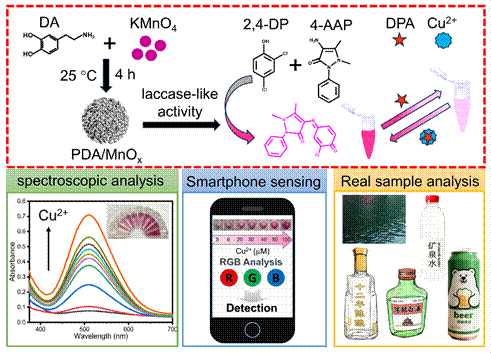
As a common trace element in the human body, Cu2+ plays a key role in various metabolic activities; however, its concentration imbalance can also lead to several diseases. Since copper equipment is often used in alcohol brewing, Cu2+ contamination in alcoholic beverages is a common issue. Therefore, accurate detection of Cu2+ content in beverage samples is crucial for ensuring food safety. This study describes a simple one-step method to prepare PDA/MnOx nanoparticles by stirring at room temperature. These nanoparticles exhibit excellent laccase-like activity, catalyzing the oxidation of 2,4-dichlorophenol and reacting with 4-aminoantipyrine to produce a pink product. D-penicillamine (DPA) acts as both an etchant for MnOx and a chelator for Cu2+, mediating the laccase-like activity of the PDA/MnOx nanoparticles. Based on this, a signal-on colorimetric detection system was constructed for the highly sensitive detection of Cu2+. Furthermore, by combining this system with a smartphone and using a color recognition app, instrument-free on-site analysis of Cu2+ in various alcoholic beverage samples can be achieved. This method provides a new strategy for designing nanomaterial-based heavy metal ion colorimetric sensors and holds significant application potential in beverage safety monitoring.
In recent years, the School of Chemistry and Environmental Engineering has placed great emphasis on cultivating undergraduates' practical and innovative abilities. After years of sustained effort, the school has established a “theory foundation—practice strengthening—innovation leading” three-in-one cultivation model that runs through the entire four-year undergraduate program. Hu Mengting is one of the beneficiaries of this model. Recommended by the school in the second semester of her freshman year, she joined Lei Zhen's research laboratory for extracurricular scientific training during the summer after her first year. After thorough training across the entire research chain—including experimental operation, literature reading, data processing, and paper writing—she achieved this remarkable result two years later. Going forward, the school will further optimize and explore effective pathways to synergistically enhance academic innovation and educational quality, promote the deep integration of research outcomes with undergraduate teaching and learning, and provide strong momentum for cultivating outstanding and innovative talents. (Reviewer: Yu Junxia)
