Newsletter (Correspondent: Jia Fengcheng) Recently, Liao Lingling, a 2023 undergraduate student majoring in Applied Chemistry at the School of Chemistry and Environmental Engineering of Wuhan Institute of Technology, published a research paper as the first author in the internationally renowned academic journal in the field of chemical engineering and technology, Chemical Engineering Science (a TOP journal of Wuhan Institute of Technology). The paper is titled “Regulating the interfacial microenvironment via oxygen vacancy in Co3O4 for boosted electrocatalytic furfural oxidation.” Wuhan Institute of Technology is the first affiliation and the corresponding affiliation. The supervising instructors of the paper are Associate Professor Xiang Kun and Professor Zou Jing from the university’s “Catalysis and Solid Waste Synergistic Innovation Team.” The research was supported by the Hubei Provincial Natural Science Foundation Project (2025AFB671) and the Hubei Provincial College Student Innovation and Entrepreneurship Training Program (S202410490009).
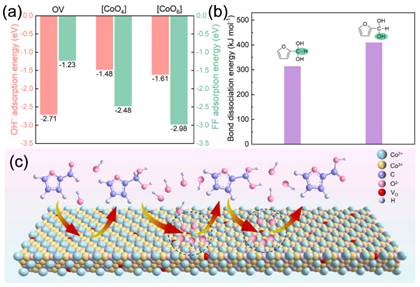
Furfural is a typical product from the hydrolysis of agricultural and forestry waste and is widely found in wastewater from biomass refining, papermaking, and other industries. It is significantly toxic to microorganisms and aquatic life, and traditional biochemical treatment methods suffer from low efficiency and long processing times. To address this environmental challenge, the research team precisely regulated oxygen vacancies on the catalyst surface to construct active sites with Lewis acid characteristics, effectively enhancing the enrichment capacity of hydroxide ions at the electrode interface and successfully mitigating localized acidification during the reaction. Experimental results show that the catalyst exhibits excellent performance in the electrocatalytic furfural oxidation reaction, achieving a furanoic acid Faradaic efficiency exceeding 93% and stable operation for over 150 hours. Theoretical calculations further reveal a synergistic catalytic mechanism between the oxygen vacancies and cobalt active sites, enabling both efficient pollutant conversion and high selectivity. This study provides a new approach for the green electrocatalytic resource recovery of toxic organic pollutants.
In recent years, the School of Chemistry and Environmental Engineering has placed great emphasis on cultivating students’ practical and innovative abilities. With the support of the teaching research project “Breaking Down Academic System Barriers, Strengthening Research Leadership – An Integrated Undergraduate-Graduate Cultivation System” led by Associate Professor Xiang Kun, Liao Lingling entered the teacher’s research laboratory for extracurricular scientific training in the summer of her freshman year. She underwent comprehensive research training covering experimental operation, literature reading, data processing, and academic writing. The successful publication of this outstanding research achievement once again validates the educational effectiveness of the school’s “Theory Foundation–Practice Strengthening–Innovation Leading” trinity cultivation model. The school will continue to actively explore effective pathways to synergistically enhance academic innovation and educational quality, vigorously promote the deep integration of research outcomes with undergraduate education and teaching, and strive to provide sustained momentum for cultivating top-notch innovative talents.
(Reviewer: Yu Junxia)
